Butterfly Survey 1976-2025
Peacock
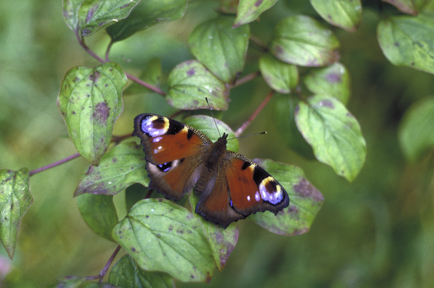
wingspan: 65 mm varies female larger
 copy.jpg)
Habit: This dark velvety butterfly is among the earliest to emerge from winter hibernation. It can be seen on Southern facing foopaths, particularly where the pathways girdle fields and are protected from North winds, typically along woodland edges. The butterfly is prolific and can be found almost everywhere where nettles are allowed to grow. The butterfly has the unusual habit of disappearing from the predators not immediately deterred by its bold eyespots. It performs this trick with an audible flick of its wings that then show as underwings and almost black in appearance, thus the butterfly resembles nothing more than a shadow. The peacock, like most of our colourful Nymphalidae species, shows a decline based around habitat loss due to nettle clearance and pesticide overspray.
Single brooded: - In spring the Peacock butterfly emerges from the outhouses and sheds where it has hibernated. This takes place, typically when the temperatures rise to about 13º C according to weather records and as early as late Janury or early February in some years 2019/2020. Mating takes place later and eggs are laid in batches on nettle and on hop, the resultant spiny caterpillars appearing as a black mass in a protective web. As the instars progress, the full grown caterpillars disperse to hibernate singly, the resultant butterflies typically emerging in mid June. These butterflies are on the wing for a very limited amount of time, relatively, before hibernation takes place. Aestivation is also a feature of the butterfly in very hot summers 1976 - 2025, where the butterfly disappears after only about a month flight time. The butterflies are more often than not then found in groups hanging upside down, wings closed in outhouses and sheds, etc.,
Larval Foodplant: nettles and hop.
Status: - fluctuating, but probably diminished overall from the start of the study.
WH - White Hill Shoreham, Fack - Fackenden BC - Bromley Common, Ha - Hayes -BN - Bromley North Eyn - Eynsford Orp - Orpington Bic - Bickley HE - High Elms Rux - Ruxley, etc.,
© Rodney Compton. Howard Walmsley